Shoulder replacement enters the discussion when pain, structural damage, and loss of useful movement persist despite appropriate treatment—not simply because an X-ray looks abnormal. By the end, you will know which symptoms, examination findings, scans, treatment history, and personal factors help determine whether replacement is reasonable and which implant design may fit.
Key takeaways
- Consider replacement when pain and disability persist despite appropriate nonsurgical care.
- Night pain, rest pain, and lost motion matter when daily tasks become difficult.
- Imaging must match symptoms; an abnormal X-ray alone does not justify surgery.
- Implant choice depends on cartilage, rotator cuff function, bone quality, and activity goals.
When Shoulder Pain and Disability Cross the Surgical Threshold
Replacement becomes reasonable when severe shoulder joint pain and disability persist despite appropriate nonsurgical care, not simply because an X-ray looks abnormal. Shoulder pain at rest, night shoulder pain that disrupts sleep, and loss of shoulder motion are strong warning signs when they prevent dressing, bathing, reaching, working, or exercising.
| Finding | What it suggests | Effect on the decision |
|---|---|---|
| Pain only with demanding activity | Symptoms remain manageable during ordinary tasks | Continue nonsurgical care and monitor progress |
| Pain during daily tasks or at night | The joint is limiting function and sleep | Discuss replacement if treatment has not provided adequate relief |
| Pain at rest with marked stiffness | Advanced joint disease is affecting comfort continuously | Replacement becomes a reasonable option when imaging confirms structural damage |
The threshold is crossed when symptoms, examination, and imaging tell the same story: persistent pain, restricted elevation or rotation, weakness, and advanced arthritis or bone damage. Before deciding, you may try activity changes, physiotherapy, anti-inflammatory medicine when safe, injections, and treatment for rotator-cuff disease.
Replacement is not automatically the answer for every severely painful shoulder. A rotator-cuff tear without destructive joint disease may need cuff treatment, while a fracture may require fixation or a different replacement. Your dominant arm, work, recreation, rehabilitation capacity, and expectations also matter; two people with similar scans can reasonably choose different treatments.
What the Examination, X-Rays, and Scans Need to Show
Severe damage is supported when pain persists at rest or at night, shoulder motion is markedly restricted, and weakness prevents dressing, bathing, reaching overhead, or sleeping. Examination should document loss of forward elevation and rotation, grinding, deformity, and whether the rotator cuff can still generate strength.
An abnormal scan without substantial disability does not, by itself, justify replacement.
| Finding | What it shows | Why it matters |
|---|---|---|
| Shoulder X-ray showing joint-space loss | Cartilage has worn down; bone-on-bone shoulder arthritis may be visible | Supports advanced arthritis when symptoms match |
| Shoulder osteophytes or humeral-head deformity | Chronic joint breakdown and altered mechanics | Explains painful movement and helps plan implant size and position |
| CT showing glenoid bone loss | The socket is eroded, tilted, or too thin for standard fixation | Can change the implant design or require bone reconstruction |
| MRI showing a torn, irreparable rotator cuff or poor muscle quality | The cuff may not centre the joint or power elevation | An anatomic replacement may fail; a reverse replacement may fit the mechanics better |
CT and MRI are selected when X-rays cannot define socket erosion, deformity, fracture complexity, cuff integrity, or muscle wasting. The surgeon combines these findings with motion, strength, bone quality, age, activity demands, and response to nonsurgical treatment.
Replacement becomes a stronger option when the structural damage and examination findings explain disabling pain rather than appearing as an incidental X-ray abnormality.
How Long to Try Nonsurgical Care Before Surgery
Most people try a structured nonsurgical plan for several weeks to a few months, rather than using a fixed deadline. The plan usually includes shoulder physiotherapy, activity modification for shoulder pain, anti-inflammatory medication when safe, and shoulder injections when pain prevents rehabilitation.
- Start with shoulder physiotherapy to maintain motion, strengthen usable muscles, and identify whether weakness comes from arthritis or rotator-cuff disease. Treating an isolated cuff problem is different from replacing the joint.
- Reduce painful loads, overhead repetition, and heavy lifting while keeping the shoulder gently active. Complete rest can worsen stiffness and make recovery harder.
- Use prescribed or over-the-counter anti-inflammatory medication only if your medical history allows it. A clinician may recommend an injection when pain remains too severe for exercises or sleep.
- Reassess after the treatment plan has been followed consistently. Moving toward replacement becomes reasonable when pain remains substantial at rest or night, function stays limited, and you still struggle with dressing, bathing, reaching, work, or sleep despite these measures.
The exact duration depends on the diagnosis, symptom severity, and treatment response. A severe fracture, rapidly worsening bone damage, or another urgent structural problem may require earlier surgery. An abnormal X-ray alone does not justify replacement when pain and disability are minor.
Persistent symptoms must match the damage and interfere with the life you want to regain.
Choosing Between Anatomic, Reverse, Partial, and Resurfacing Replacement
The implant design follows four findings: which joint surfaces are worn, whether the rotator cuff works, how a fracture has changed the anatomy, and whether the bone can hold components. A severe X-ray alone does not select the operation.
| Option | What it replaces | When it applies |
|---|---|---|
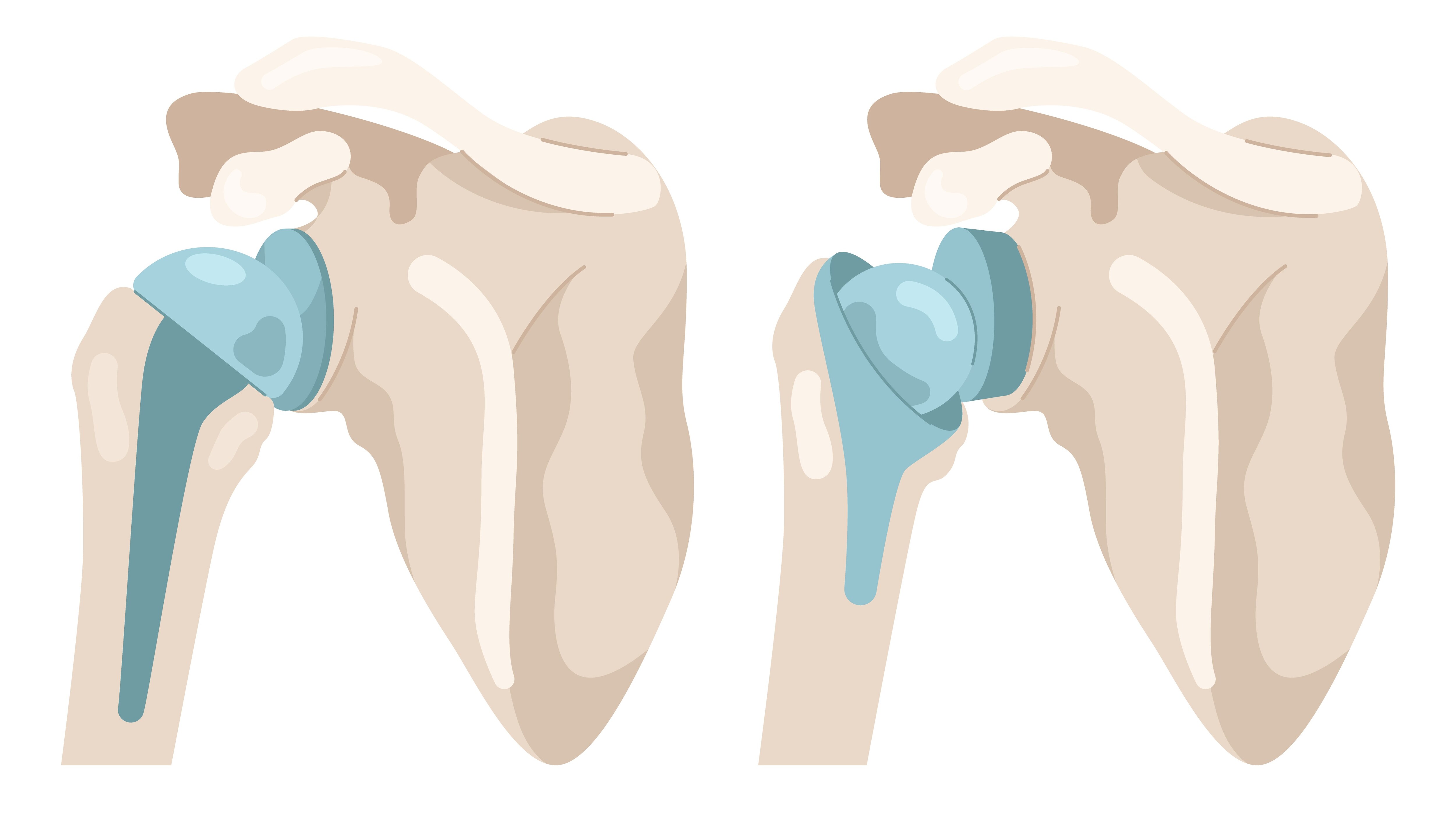
| Anatomic total shoulder replacement | Humeral head and glenoid, preserving normal ball-and-socket orientation | Arthritis affecting both surfaces with an intact, functioning rotator cuff |
| Reverse shoulder replacement | Switches the ball and socket so the deltoid raises the arm | Irreparable cuff deficiency with painful joint damage, cuff-tear arthropathy, selected complex fractures, or failed replacement |
| Shoulder hemiarthroplasty | Humeral head only | A damaged humeral head with a usable glenoid, including selected fractures; a severely damaged glenoid makes pain relief less predictable |
| Shoulder resurfacing | Caps the humeral head while preserving more bone | Younger or active patients with suitable humeral bone, limited glenoid damage, and a functioning cuff |
A torn cuff alone does not justify joint replacement; cuff repair or another treatment may fit better. CT can show glenoid bone loss and fracture displacement, while MRI assesses cuff tears and muscle quality. Poor bone may prevent secure fixation and change the plan toward another implant or fracture fixation.
Cuff deficiency makes an anatomic design prone to poor mechanics, whereas a reverse design has distinct risks, including instability, not simply a different version of the same operation.
When Replacement Is the Wrong Choice—and How to Make the Decision
Replacement is the wrong choice when the diagnosis does not match the implant, the patient cannot safely undergo anaesthesia, or an active problem has not been corrected. Shoulder replacement contraindications include an active shoulder infection, uncontrolled medical illness, severe nerve dysfunction, and inability to follow protection and rehabilitation instructions.
| Situation | Better path | Why |
|---|---|---|
| Active infection or untreated skin infection | Treat the shoulder infection before surgery | An implant placed during infection can develop a deep, difficult-to-eradicate infection |
| Isolated rotator-cuff tear without advanced joint damage | Rotator cuff treatment, physiotherapy, or repair | Replacing the joint does not repair a torn cuff |
| Displaced fracture with repairable bone and stable tuberosities | Fracture fixation | Preserving the native joint can avoid implant-related complications |
| Severe medical risk or inability to complete rehabilitation | Medical optimisation or continued nonsurgical care | Anaesthesia and recovery may create more harm than benefit |
Ask the surgeon which findings support anatomic replacement, reverse replacement, hemiarthroplasty, fixation, or no operation. Discuss bone quality, cuff function, expected activity, implant longevity, and the possibility of revision, especially if you are young or highly active. Review shoulder replacement recovery and risks, including infection, instability, fracture, nerve injury, stiffness, loosening, wear, and reverse-replacement complications.
Dr. Manohar Rao Ortho can help compare these options by matching the proposed operation to your scans, cuff function, medical fitness, and daily goals.
Related services
Shoulder Replacement Shoulder replacement is a highly effective surgical procedure for relieving severe shoulder pain and restoring joint function in patients with... View service → |
Shoulder Hemiarthroplasty Replacement Shoulder Hemiarthroplasty Replacement Shoulder hemiarthroplasty involves replacing only the humeral head (ball of the shoulder joint) with a metal implant while preserving the natural... View service → |
Frequently asked questions
When does shoulder pain cross the threshold for replacement surgery?
Replacement becomes reasonable when severe pain and disability continue despite appropriate nonsurgical treatment and interfere with sleep, dressing, bathing, reaching, work, or exercise.
What must an examination, X-ray, or scan show before shoulder replacement?
Your symptoms and examination findings must match structural damage such as advanced arthritis, joint-space loss, bone changes, or an irreparable rotator cuff problem. An abnormal X-ray alone is not enough.
How long should you try nonsurgical care before shoulder replacement?
The timing depends on the diagnosis, symptom severity, treatment response, and functional loss. Discuss surgery after appropriate options such as activity changes, medication, physiotherapy, or injections fail to provide useful relief.
How do surgeons choose between anatomic, reverse, partial, and resurfacing replacement?
The choice depends on cartilage damage, rotator cuff function, bone loss, age, bone quality, activity goals, and the condition of the shoulder joint.
When is shoulder replacement the wrong choice?
Replacement is the wrong choice when pain comes from a treatable source outside the joint, symptoms remain manageable, imaging does not match the examination, or nonsurgical care has not been adequately tried.