Knee cartilage has an important role in allowing smooth joint movement and distributing forces across the joint. When cartilage is damaged by trauma, repetitive loading, sports injuries, or other joint problems, symptoms can range from occasional discomfort to persistent pain and swelling.
Cartilage injury treatment needs to consider the size and location of the damaged area as well as the condition of the rest of the knee.
Cartilage Damage Is Not a Single Condition
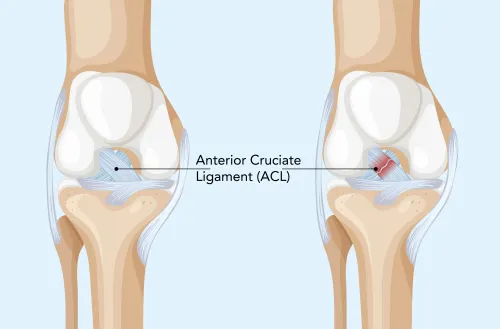
Articular cartilage covers the ends of bones inside the knee. Unlike many other tissues, it has limited natural healing capacity because it does not have a direct blood supply.
Damage can be focal, affecting a relatively small area, or more widespread as part of degenerative joint changes.
This distinction is important. A focal cartilage defect in a younger patient after an injury is not managed in exactly the same way as generalised cartilage loss associated with osteoarthritis.
Symptoms Can Be Subtle
Patients may experience:
- Pain during weight-bearing
- Recurrent swelling
- Difficulty with stairs
- Catching sensations
- Reduced sporting ability
- Discomfort after prolonged activity
Symptoms depend partly on where the defect is located and how much load passes through that part of the joint.
Assessment Looks Beyond the Cartilage
A cartilage defect should not be evaluated in isolation.
An orthopaedic assessment may consider knee alignment, ligament stability, meniscus condition, activity level, previous injuries, age, and the overall health of the joint.
MRI can provide useful information about cartilage and associated soft-tissue injuries. Weight-bearing X-rays may also be relevant when assessing joint alignment and degenerative changes.
Conservative Care Has an Important Role
Some cartilage injuries can initially be managed through non-surgical measures.
Treatment may involve activity modification, physiotherapy, strengthening, weight management where relevant, and appropriate symptom-control measures.
The goal is often to improve joint mechanics and reduce unnecessary stress on the symptomatic area.
For active patients in Bangalore, this does not always mean giving up sport. It may involve temporarily adjusting training while strength and movement patterns are addressed.
When Surgical Options Are Evaluated
Selected focal cartilage defects may be suitable for surgical treatment, particularly when persistent symptoms affect activity despite appropriate conservative management.
Several cartilage procedures exist, and their suitability depends on defect size, depth, location, patient factors, and associated knee problems.
There is no universal cartilage procedure that is appropriate for every knee.
Dr. Manohar Rao Ortho can assess cartilage injuries alongside alignment, ligament function, meniscal health, and the patient's activity requirements before discussing treatment options.
Joint Preservation Requires a Wider View
Treating cartilage effectively often means identifying factors that may be placing excessive stress on the damaged area.
For example, significant instability, meniscus deficiency, or abnormal alignment can influence how forces pass through the knee. Addressing only the visible cartilage defect without considering these factors may provide an incomplete treatment strategy.
Patients in Bangalore with recurring knee swelling, persistent activity-related pain, or symptoms after a previous knee injury can benefit from evaluation to determine whether cartilage damage is contributing to the problem. Cartilage injury treatment is most useful when it is tailored to the specific defect and the overall mechanics of the knee.
Keywords