An implant is not a single off-the-shelf piece: its materials, fixation, bearing, constraint and size must match your bone, ligaments and goals. By the end, you will know how the parts differ, which questions to ask before consent, what affects implant longevity and how to keep the device record for future care.
Key takeaways
- A knee replacement uses metal components with a polyethylene bearing insert.
- Ask your surgeon whether fixation will use bone cement, press-fit fixation, or both.
- Protect implant longevity by managing weight, avoiding high-impact overload, and attending follow-ups.
- Keep your implant brand, model, size, serial number, and surgery date.
What Parts Make Up a Knee Replacement Implant?
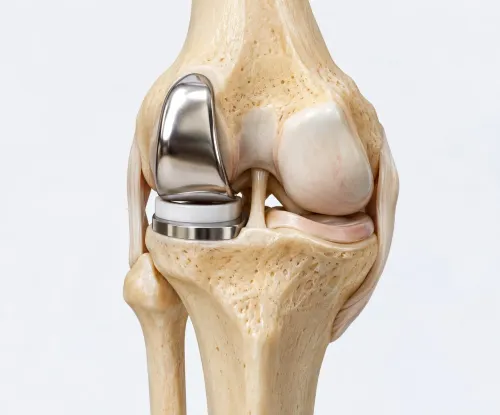
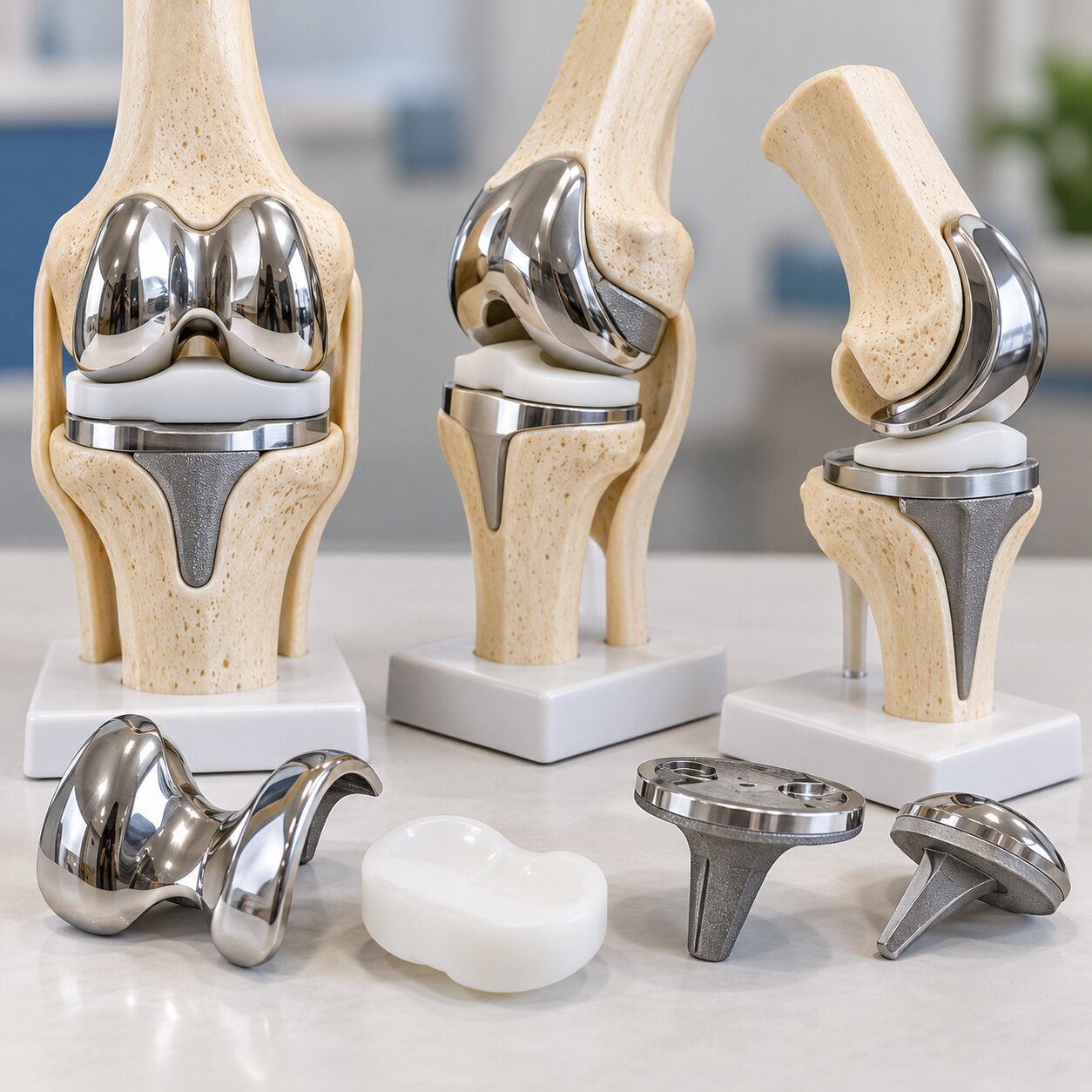
A total knee replacement usually has three functional parts. The metal femoral component caps the end of the thighbone, while the metal tibial baseplate, or tray, sits on the top of the shinbone. A polyethylene insert locks into the tibial baseplate and provides the bearing surface between the two metal components.
If the surgeon resurfaces the underside of the kneecap, a polyethylene patellar component is added; patellar resurfacing is not routine in every operation.
| Replacement type | Area replaced | What must remain suitable |
|---|---|---|
| Total knee replacement | All three knee compartments | The surgeon chooses components for the knee’s bone shape, alignment and ligament stability |
| Partial or unicompartmental replacement | One damaged compartment only | The other compartments, remaining cartilage, bone and major ligaments must function well |
A partial replacement is not simply a smaller total knee implant. The polyethylene insert is a bearing surface, not an indestructible cushion: wear particles can trigger inflammation and osteolysis, which can contribute to loosening or instability over time.
Components come in different sizes and designs, so a brand name—or claims such as “advanced”—does not show whether the system fits your knee. Size, anatomy, ligament function and the surgeon’s plan matter more.
How Are Implants Fixed and Stabilised Inside the Knee?
Bone cement, bone ingrowth, or both keep knee components attached to bone. Cemented fixation uses bone cement to anchor the femoral and tibial components immediately. Cementless fixation uses a textured surface; a press-fit implant is held tightly in prepared bone while new bone grows onto it.
Hybrid fixation combines methods, such as cementing one component while allowing biologic ingrowth on another.
Fixation choice is not a ranking. Bone quality, anatomy, age, deformity and the surgeon’s assessment determine which approach fits your knee.
| Option | How it works | Main consideration |
|---|---|---|
| Cemented fixation | Bone cement anchors the component | Immediate fixation, but later loosening can still occur |
| Cementless fixation | Bone grows onto a textured surface | Requires suitable bone for reliable ingrowth |
| Hybrid fixation | Combines cemented and cementless components | Uses different fixation strategies in one knee |
Ligament preservation changes the implant’s stabilising design. A cruciate-retaining implant preserves the posterior cruciate ligament when it remains functional. A posterior-stabilised implant removes that ligament and uses a cam-and-post mechanism to guide movement instead.
Insert design also involves a trade-off. A fixed-bearing polyethylene insert keeps its contact surface stationary on the tibial tray; a rotating-platform insert allows the polyethylene bearing to rotate, providing mobility but adding another moving interface.
Constrained implants provide extra stability for major ligament instability, severe deformity or revision surgery. Greater constraint transfers different forces to the bone, so it is not an automatic upgrade; surgeons use it when ordinary ligament balancing and less-constrained designs cannot provide a stable knee.
How Does the Surgeon Choose the Implant for Your Knee?
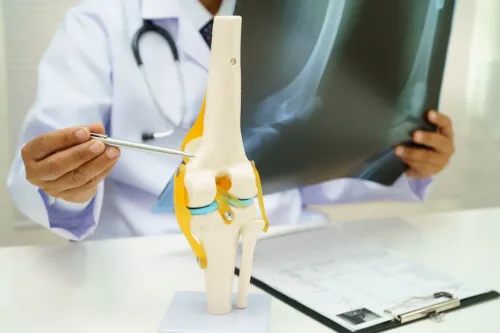
The surgeon chooses an implant from your anatomy, ligament function and surgical goals—not from a universally “best” brand. Standing X-rays show bone shape, joint-space loss, deformity and alignment; CT or other imaging adds detail when bone loss or unusual anatomy is suspected. Examination tests ligament stability, range of motion and soft-tissue balance.
Bone quality affects cemented, cementless or hybrid fixation. A functioning posterior cruciate ligament may suit a cruciate-retaining design; deficient ligament function may require a posterior-stabilised implant or greater implant constraint. Severe deformity or bone loss can require specialised components. Your activity goals matter, but they cannot override unstable ligaments, poor bone support or unsuitable alignment.
| Option | What it supports | Important limitation |
|---|---|---|
| Manual instruments | Conventional bone cuts and component positioning | Depends heavily on planning, guides and surgical judgment |
| Patient-specific cutting guides | Planned cuts based on your imaging | A guide does not choose the implant or guarantee accurate balance |
| Robotic or computer-assisted systems | Planning, alignment checks and component positioning | Technology does not guarantee better pain relief, function or implant survival |
- The manufacturer, model, implant size and confirmation that it is approved for its intended use
- The planned fixation method, bearing design and expected implant constraint
- The alternatives considered, including why another design does not suit your knee
At Dr. Manohar Rao Ortho, use the consultation to connect these answers to your X-rays, ligament examination and activity goals.
Related services
Knee Replacement also known as knee arthroplasty, is a transformative surgical procedure that relieves pain and restores function in severely damaged knee joints. View service → |
Primary Knee Replacement Primary Total Knee Replacement is the most common type of knee surgery performed by Dr. View service → |
How Long Can an Implant Last, and What Raises the Risk of Failure?
Implant survival means the components have not been revised; it does not mean the knee is pain-free or functions like a normal knee. Registry and cohort data report approximately 82% survival at 25 years and about 70% at 30 years, but results vary with the patient, implant and follow-up period.
That is a population estimate, not a promised implant service life.
Younger age, higher body weight and greater cumulative activity increase demands on the polyethylene bearing. Polyethylene wear can release particles that trigger inflammation, osteolysis and implant loosening, but activity alone does not determine failure. Later revision may result from:
- Infection
- Loosening or wear
- Instability
- Fracture around the implant
- Stiffness
- Persistent pain
Repeated high-impact running and jumping can increase loads on the replacement. After recovery, walking, cycling, swimming and golf are commonly used activities; your surgeon should tailor advice to your knee, bone quality and stability. Kneeling can remain uncomfortable even when the implant is functioning well.
Tell your surgeon about a reported nickel or metal allergy, especially a serious reaction to jewellery or a previous implant. It does not prove that a knee implant will cause a reaction, and routine skin or blood allergy testing is not universally recommended.
Ask how your history changes the implant choice instead of assuming that testing or a “hypoallergenic” component is automatically necessary.
What Implant Information Should You Keep After Surgery?
Keep an implant record with your medical documents; it can answer urgent questions years after surgery. Ask the hospital for the manufacturer, implant model, component sizes, and lot or serial information when available.
Request the implant sticker sheet and operative note before discharge. The sticker sheet often identifies each component placed in your knee. Provide these records to future orthopedic surgeons, emergency clinicians, and imaging centers.
Most modern knee implants have MRI compatibility under specified conditions, but the exact device labeling controls the permitted scanner strength, positioning, and settings. Metal can also create image artifact. Tell the imaging center about your knee implant before an MRI and provide the implant record rather than assuming every MRI protocol is safe.
Routine antibiotics before dental procedures are not recommended for most joint-replacement patients. The 2024 AAOS/ADA guidance found that routine systemic prophylaxis may not reduce prosthetic-joint infection risk. If you have selected high-risk circumstances, ask your orthopedic and dental teams to decide together.
Before consenting, confirm that your records will include:
- Manufacturer, model, component sizes, lot or serial details, and the implant sticker.
- Fixation method, constraint level, bearing design, and alternatives considered.
- MRI conditions, including permitted scanner strength and settings.
- The follow-up plan and who to contact about new pain, swelling, instability, or infection.
Frequently asked questions
What parts make up a total knee replacement implant?
A total knee replacement has a metal femoral component, a metal tibial baseplate, and a polyethylene insert between them. A patellar component may also be used on the underside of the kneecap.
How is a knee replacement implant fixed inside the knee?
The implant can be fixed with bone cement, press-fit fixation that allows bone to grow onto the component, or a combination of both methods.
How does a surgeon choose a knee replacement implant?
The surgeon considers your bone quality, knee anatomy, ligament stability, deformity, activity needs, age, and the implant design that provides reliable balance and movement.
How long can a knee replacement implant last?
Implant lifespan depends on factors such as activity impact, body weight, alignment, infection, instability, wear, and loosening. Regular follow-up helps identify problems early.
What implant information should you keep after surgery?
Keep your implant brand, model, component sizes, serial or lot numbers, fixation method, surgery date, and hospital or surgeon records.
Related service
Complex Knee Replacement Complex or Revision Knee Replacement is performed in cases of failed previous surgeries, severe deformities, infections, or significant bone loss. View service → |