Severe knee pain does not by itself determine whether you need a partial replacement, a total replacement, or another treatment. The decision depends on where the cartilage has failed, whether the rest of the knee still works normally, and what examination and weight-bearing imaging reveal.
Key takeaways
- Partial replacement treats damage limited to one knee compartment.
- Ligament stability, knee alignment, and imaging help determine whether UKA fits.
- Widespread arthritis, inflammatory disease, or ligament damage can favour total replacement.
- Your activity goals, weight, age, and expectations influence the recommendation.
What does “unilateral knee replacement” mean in this decision?
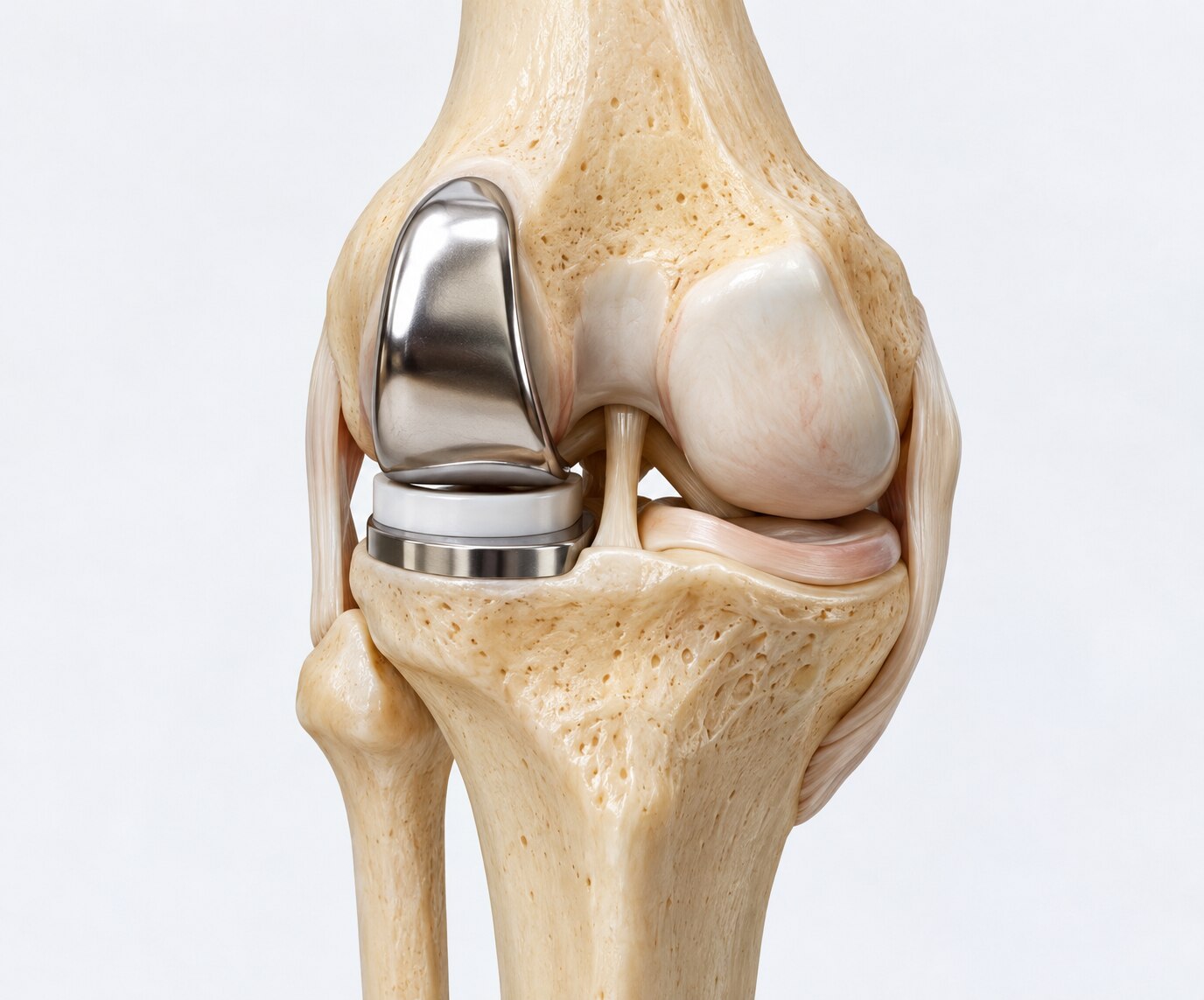
Unilateral knee replacement has two distinct meanings. It can mean replacing one knee rather than both knees, or replacing only one damaged compartment within a single knee. The second meaning usually refers to unicompartmental knee replacement, partial knee replacement, or unicondylar knee arthroplasty (UKA).
- Medial compartment: the inner joint space between the thighbone and shinbone.
- Lateral compartment: the outer joint space between the thighbone and shinbone.
- Patellofemoral compartment: the joint between the kneecap and thighbone.
Damage limited to one compartment matters because a partial implant relies on the rest of the knee. The remaining compartments must retain useful cartilage, and the ligaments and bone surfaces must still support reasonably normal mechanics.
For example, isolated medial-compartment arthritis can make a medial UKA worth considering when the lateral and patellofemoral compartments remain functional.
A knee with widespread cartilage loss is not treated with a smaller version of total knee replacement. If arthritis affects multiple compartments, the surgeon must address the broader joint damage rather than resurface one area and leave diseased surfaces behind.
The choice therefore depends on the damage pattern, examination findings, alignment, ligament function, and symptoms—not on the word “unilateral” alone.
Which clinical findings make a partial replacement worth considering?
Partial knee replacement criteria start with substantial, persistent symptoms despite appropriate nonoperative care—not an X-ray label alone. Exercise-based rehabilitation, weight management when relevant, medicines when safe, and selected injections should have failed to restore useful function.
The practical eligibility pattern includes:
- Pain clearly centred in the damaged medial or lateral compartment, with limited walking distance, disturbed sleep, or difficulty climbing stairs and completing daily activities.
- Isolated compartment arthritis shown on weight-bearing radiographs, with useful cartilage preserved in the other compartments.
- An intact ACL and stable collateral ligaments.
- Useful knee motion, acceptable alignment, and a correctable deformity during examination rather than a fixed varus or valgus position.
| Finding | Supports partial replacement | Raises concern for total replacement |
|---|---|---|
| Symptoms | Localised pain with meaningful functional loss | Widespread pain or modest symptoms |
| Radiographs | Isolated medial or lateral joint-space loss under load | Cartilage loss across multiple compartments |
| Examination | Stable ligaments and correctable deformity | ACL deficiency, major stiffness, or fixed deformity |
An intact ACL helps preserve normal knee stability because a partial implant does not replace the cruciate ligaments. An ACL-deficient knee can shift or feel unstable and often favours total knee replacement, although selected modern procedures address some ACL-deficient cases.
“Bone-on-bone” medial disease alone does not establish candidacy. The surgeon must also confirm the pain pattern, preserved compartments, ligament function, knee motion, alignment, and absence of inflammatory or widespread post-traumatic damage.
How do examination and imaging confirm the damage pattern?
The assessment starts with your symptoms, not the X-ray. The surgeon asks where the pain occurs, when it appears, how far you can walk, whether the knee gives way, and which treatments have failed. Pain limited to one compartment supports partial replacement only when the rest of the knee and its mechanics remain reliable.
The physical examination checks:
- Range of motion, including a flexion contracture or severe stiffness
- Fixed varus or valgus deformity and whether the alignment can be corrected
- ACL and collateral-ligament stability
- Tenderness in the medial, lateral, and patellofemoral compartments
- Gait, swelling, warmth, and other signs of infection or inflammatory arthritis
The surgeon then matches these findings with weight-bearing studies.
| Study | What it shows | Why it matters |
|---|---|---|
| Standing long-leg alignment film | Hip-to-ankle mechanical alignment | Shows varus or valgus loading across the entire limb |
| Weight-bearing knee X-ray, using anteroposterior or posteroanterior views | Joint-space loss under load | Reveals compartment narrowing that non-weight-bearing films can understate |
| Lateral X-ray | Side view of joint surfaces and flexion-related changes | Complements front-view assessment |
| Skyline patellar view, also called sunrise or Merchant view | Patellofemoral joint damage | Detects disease that could change the implant choice |
MRI for knee replacement is reserved for an unclear diagnosis, suspected cartilage or ligament damage not explained by X-rays, or an unusual pattern. It is not routinely needed when examination and radiographs clearly show isolated osteoarthritis.
If symptoms, blood tests, or examination raise concern for infection, the surgeon evaluates it before implant surgery rather than assuming ordinary arthritis.
When is total knee replacement safer or more appropriate?
Total replacement is safer or more appropriate when damage extends beyond one compartment, knee mechanics cannot be restored, or surgery is unsafe. Pain severity alone does not establish the right operation.
| Operation | What it addresses | When it fits |
|---|---|---|
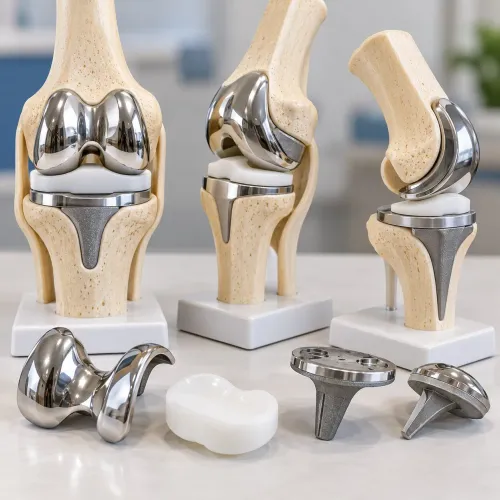
| Unicompartmental knee replacement | Resurfaces the affected medial or lateral tibiofemoral compartment while preserving the other compartments, patella, and functioning cruciate ligaments | Disease is isolated and alignment, motion, and ligament stability remain usable |
| Total knee replacement | Replaces damaged joint surfaces across the knee | Arthritis affects two or more compartments or cartilage loss is diffuse |
Total replacement usually suits substantial patellofemoral or lateral disease, rheumatoid arthritis and knee replacement needs caused by inflammatory polyarthritis, a fixed knee deformity that cannot be corrected, major flexion contracture or stiffness, severe ligament instability, or extensive bone loss.
Do not proceed with either implant until active infection is assessed and treated. An unsafe, uncontrolled medical condition can also postpone or rule out surgery.
The trade-off is important: partial replacement preserves more bone and native anatomy, often gives faster early recovery, and can feel more natural when correctly indicated. It also carries a higher chance of knee replacement revision because arthritis progresses in an untreated compartment, the bearing wears or dislocates, the implant loosens, infection develops, or pain persists.
Revision commonly converts the partial implant to a total replacement.
How do age, activity, weight, and expectations change the recommendation?
Age and partial knee replacement are not linked by a fixed cutoff. Older age does not automatically rule out partial replacement, and younger or active patients are not automatically excluded; anatomy remains decisive. Patient factors modify that assessment by changing durability, safety, and the activity the implant can reasonably support.
| Factor | How it changes the discussion | Main concern |
|---|---|---|
| High-impact sport or heavy work | Match activity after unicompartmental knee replacement to lower-impact goals | Wear, loosening, progression of arthritis, or revision |
| Obesity | Weight and knee replacement decisions require individual assessment, not a weight-only rule | Greater loading and possible implant failure |
| Long-term kneeling | Discuss whether work or daily tasks can be changed | Repeated loading and persistent discomfort |
| Previous knee surgery | Review its effect on alignment, bone stock, ligaments, and cartilage | A partial implant may be unreliable or technically difficult |
Ask which compartments are damaged, whether the ACL and collateral ligaments function, whether alignment is correctable, and what standing radiographs show under load. Ask how often the surgeon performs both partial and total replacements; a knee replacement second opinion from someone offering both options can expose a different interpretation of the same anatomy.
Dr. Manohar Rao Ortho in J. P. Nagar, 8th Phase, Bengaluru can review these findings and compare options without treating age, weight, or pain alone as an automatic yes-or-no rule. Your realistic goals matter as much as the X-ray.
Related service
Unicondylar Knee Replacement Unicondylar or Partial Knee Replacement is ideal for patients whose arthritis is confined to one compartment of the knee. Dr. View service → |
Frequently asked questions
What does unilateral knee replacement mean?
It can mean replacing one knee rather than both, or replacing only one damaged compartment within a knee. The second meaning is partial or unicompartmental knee replacement.
Which clinical findings make partial knee replacement worth considering?
Partial replacement is considered when arthritis is confined to one compartment, the remaining cartilage is healthy, the knee has manageable alignment, and the major ligaments remain stable.
How do examination and imaging confirm the damage pattern?
A clinician checks pain location, movement, alignment, ligament stability, and walking pattern. Weight-bearing X-rays show joint-space loss and alignment; MRI is used when cartilage, meniscus, or ligament damage needs clarification.
When is total knee replacement safer or more appropriate?
Total knee replacement is usually more appropriate when arthritis affects multiple compartments, the knee is severely deformed or stiff, inflammatory arthritis is present, or important ligaments are insufficient.
How do age, activity, weight, and expectations change the recommendation?
The decision considers biological age, activity demands, body weight, bone quality, ability to follow rehabilitation, and expectations about pain relief, movement, implant durability, and future surgery.